Interviewing
Interviewing Process
Job interview—just the sound of these two words often makes for sweaty palms and pounding hearts. But, is there a way to reduce the stress level of this critical step in the job search process? Yes—be prepared!
An interview is simply an exchange of information between two or more people for the purpose of communicating one's qualifications for a job. Sounds easy, right? It can be, if you take the right steps.
What to expect
Before the interview
Preparation is key. You need to arrive at the interview armed with information. You need to know yourself, the industry, the organization, and how it all fits together.
Research yourself
Be ready to talk about anything and everything that's on your resume and expand upon it. Think about not only what you've done, but also about how these experiences relate to your accomplishments, your strengths and weaknesses, and your future goals. Think about each experience in terms of what you learned and what skills you developed. Think about what makes you unique.
Consider these points:
-
How do my skills meet the job requirements?
-
What are my strengths for this position?
-
What are my weaknesses?
-
How do my long-term goals fit this job and this organization?
-
What did I learn from my last three jobs/activities that will be useful in this job?
Research the Industry
Be prepared to convince the employer that this is your committed area of interest. You have to demonstrate knowledge of the field to show this commitment. Read the appropriate trade publications (many are available at The Center for Career Education), such as The Wall Street Journal for finance, The Nonprofit Times for nonprofit, and so on. Talk to friends or alumni working in these areas. Surf the Internet for relevant information. Let potential employers know that you know what this field is all about and this is where your skills and talents would best be utilized.
Questions to answer about the industry include:
-
Who are the main employers in this field?
-
Where are they located geographically?
-
What are current trends/news within the field?
-
What is the future for the field?
-
What are common trade/professional associations?
Research the Organization
Being knowledgeable about the organization is one of the most important things you can do to set yourself apart from the crowd. CCE recruiters cited research as the top way that students could better prepare for interviews. You need to do this to personalize the interview, and show the employer that they should hire you because you are committed to working for them, not their competitors. Speak to people you know working for these companies to find out inside information (both about their organization and the industry).
Go in to your interviews armed with information about the following:
-
Mission of the organization
-
Major projects or services
-
Major clients
-
Organizational structure and key people
-
Department's role as relates to the organization's mission
-
Qualifications sought
-
Job responsibilities
-
Current news or events
-
Size/Branch locations
-
Reputation-view by clients, suppliers, or competitors
Once you have all of this information, think about how it all fits together. Be able to answer why you are a good fit for a particular organization in a particular industry. In addition to doing research, practice answering interview questions with a friend or make an appointment with an advisor for a practice interview.
Professional Dress
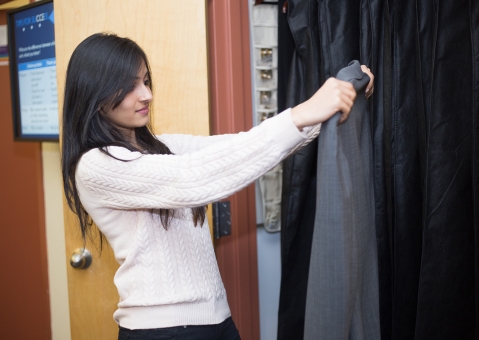
The first two minutes of the interview are crucial. Impressions are formed very quickly and can be lasting, so it is important to make a strong first impression. Presentation is the first thing a potential employer will notice, so dress appropriately. Through your research, you should have gained an understanding of the dress code for the industry and organization. When in doubt, it is better to be too conservative than too flamboyant. Different industries have their own "standard dress code." For example, financial firms, insurance companies, and banks tend to be very conservative. Educational institutions, publishing firms, and nonprofit organizations tend to be more lenient when it comes to interview attire. Research the organization and industry to evaluate what is most appropriate.
Women
Wear a suit, jacket, and skirt, or a professional dress. Choose conservative colors and a modest skirt length, neutral hose without snags or runs, and a conservative blouse.
Men
Wear a conservative color, such as navy or gray, a tie which doesn't draw attention to itself, a pressed shirt –(preferably white), and socks that match one another. Never wear white socks.
Shoes
They should be in good condition, polished with no scuffmarks, and not run-down in the heels. Heels should be a comfortable height. Avoid wearing open-toed shoes or sling backs.
The Greeting
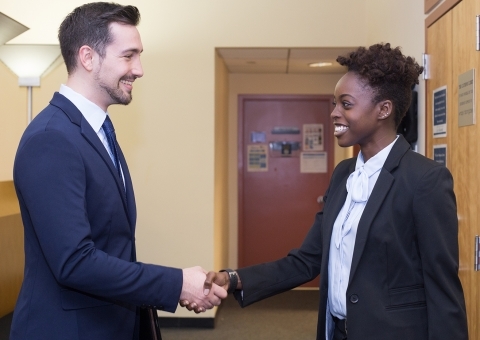
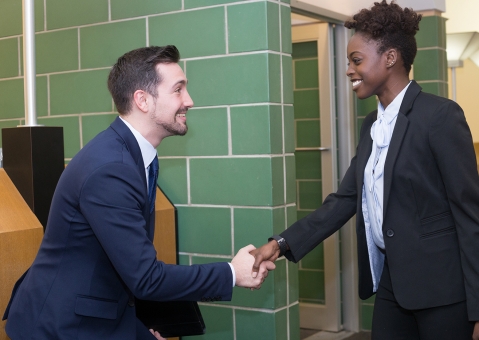
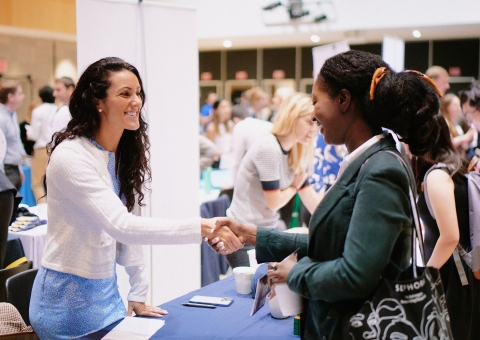
It is extremely important to arrive on time or about ten minutes early for your interview. If your interview is at CCE make sure to check in with our receptionist at the front desk. When greeting your interviewer, rise, make eye contact, and offer a firm handshake. Pay attention when your interviewer introduces himself/herself. It is important to get the person's name right.
During the interview
You want to prove to the interviewer that you are the right person for the job. As you answer each question, consider how well you are proving this. The best way to be successful is to listen to the interviewer's questions carefully. Pause for a moment to collect your thoughts before charging ahead with your answer. Watch your interviewer for his/her reactions to your answer and maintain eye contact.
The Dreaded Silence
Be aware of the silences during an interview. When you have finished answering a question, there may be a pause before the next question is asked. Resist the urge to fill the silence with an extension of your previous answer. You are rarely adding to your case. Instead, you tend to weaken it with irrelevant information. Calmly wait for the next question instead of filling the silence.
Be Professional
Professionalism is crucial during all phases of the interview. This includes being courteous to everyone with whom you interact during your application process. Being rude to an assistant or a receptionist will probably come back to haunt you. In most cases, your interviewer will be informed of your behavior. Remain professional if the interview takes place over a meal or with people who will be your peers. These types of interviews tend to take on a casual air but remember, you are still being judged on everything you say and do. Graduating students should take advantage of the Business Etiquette Dinner in early fall to prepare for this type of meeting.
Be Honest
Be honest when answering questions. Do not claim to have skills and knowledge that you lack. However, remember that being honest does not mean that you must tell everything about yourself. The interviewer is most interested in the aspects of your experience and background that apply to the position.
Focus on the positives in your background, not the negatives.
At an interview, you should never apologize for something that you have or have not done. Never say that you "just" did something (i.e., "I was just an intern"). There is no reason to minimize your experiences.
Answering Tough Questions-Tell Me About Yourself
This innocent sounding question is one of the hardest interview questions to answer. What is the employer looking for? However, this is also one of the best questions to be asked. At no other time will you be given so much latitude to answer a question. You want to be sure to capture the interviewer's attention with a clear, quick, and focused response. This response should give a summary of who you are, focusing on why you are a good fit for this position in this organization. The employer is not looking for your whole life story.
Prepare your own questions
What should I ask them?
At the end of most interviews, you will be given the opportunity to ask questions. Make sure you are ready with questions that demonstrate your genuine interest in the position and the organization. Your research may have raised some questions or the interviewer may have mentioned something you'd like to know more about. Now is the time to ask. Think about the information you still need to know in order to make a decision should an offer be made. It is also appropriate to ask about the time frame for filling the position. Avoid asking about salary and benefits.
Potential questions
-
Can you tell me a little about your own experience with this organization?
-
What types of projects will I be working on?
-
What do you see in the future for this industry?
-
How do you feel about promotions from within?
-
How do you rate your competition?
-
When can I expect to hear from you?
On-Campus Interview Tips
-
Arrive about 10 minutes early.
-
Check in at the front desk for your interview room assignment.
-
Wait to be called in the area outside of the Career Resource Center.
-
Keep in mind that recruiters and greeters will be all around the career center.
Although you will be on campus, you should act as you would if you were in their office for an interview.
Off-Campus Interview Tips
-
To avoid confusion, make a practice run to your interview destination. Get cash, train tickets, and gas—everything that will make for a smooth, on-time arrival.
-
While you wait, people-watch to pick up clues about the office culture. Use this information as you decide which environment is the best fit for you.
After the Interview
Do not bombard the interviewer with phone calls or letters. If they have told you that they will contact you, wait for them to call. If they have not called by the time they said they would, then it is acceptable to call them.
Remember, every job is not for everyone. Be well prepared and realistic as you go into each interview. Learn from rejections and mistakes so that you will not make them again. Stay calm during your interviews, and present yourself in the best way that you can. Keep in mind your primary goal: convincing the interviewer that you are the best person for the position.
Behavioral Interviews
Many times, interview questions will take the form of "tell me about a time when…." This is because employers are looking to hire candidates who can demonstrate many different skills and abilities. The belief is that the past behavior can predict future behavior. To assess this, the employer will ask you open-ended questions that require you to describe a situation when you demonstrated a particular skill. Several examples of this are:
-
Tell me about a time when you faced a difficult situation and resolved it. (measures problem solving and decision making)
-
Tell me about a time when you taught or persuaded someone to do something (measures spoken commitment)
-
Tell me about a time when you were a successful team leader as well as a team member. (measures leadership/team building)
-
Tell me about a time when you adapted to the changing goals of a project before its completion. (measures managing ambiguity and flexibility)
The key to answering these questions is to first assess what skill the employer is trying to learn about. Then, select an example that best proves this. Examples may be drawn from a variety of experiences, including work, volunteer/community service, extracurricular activities, and academics. Give a brief background so that the employer understands the context, describe the situation, explain what action you took, and conclude with the result.
The Interview Checklist
Before going on your interview, review this final checklist to make sure you are ready!
-
Have you researched yourself, the organization and the industry? Do you know how they all fit together?
-
Have you practiced answers to interview questions either with a friend or a career counselor?
-
Do you have the appropriate clothes for the industry?
-
Do you know where you are going for the interview? Have you done a test run to see how long it takes to get there?
-
Do you have extra copies of your resume and a list of your references? Have you asked your references for permission to give out their names?